How Tender Rejection Rates Impact Dry Van Operations Around Milwaukee
Preface
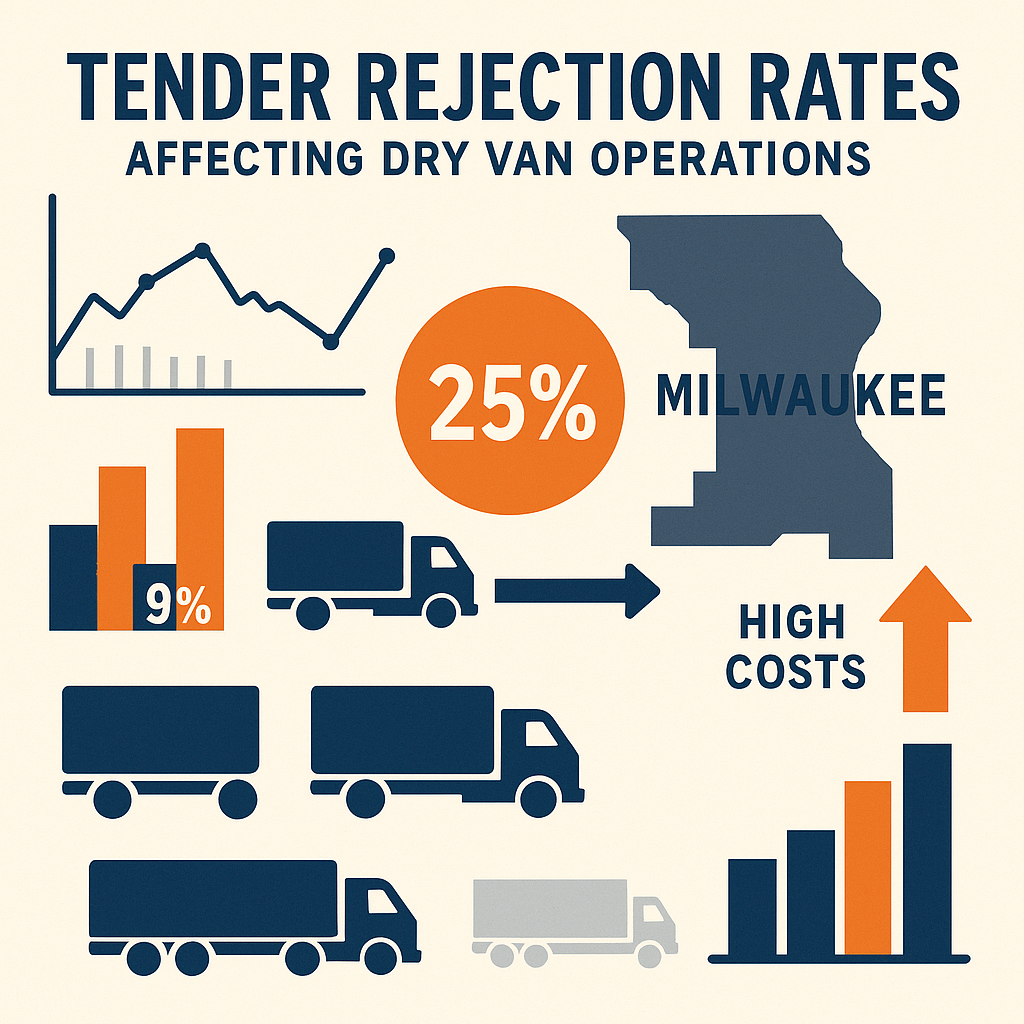
In the field of freight logistics, tender rejection rates are regarded as an essential indicator of the state of the market — especially in thriving places like Milwaukee. When carriers deny shipment offers too many times, frustration arises that leads to problems like: delivery delays, strained carrier connections, and high costs. This article describes how tender rejection Milwaukee trends influence the operations of dry vans, the importance of dry van rejections, and the practical measures — tracking to reduce rejections — that fleets can apply to remain competitive. We will share the tender cycle, discuss frequently seen rejection triggers, and provide tools such as DAT insights that are available to fleets in times of capacity squeeze.
The Tender Cycle Cycle in Milwaukee
Every freight lane follows a unique rhythm, again repeating a rough sequence of a tender cycle, as influenced by local factors (e.g. seasonal manufacturing surges around Lake Michigan or holiday-driven retail spikes). In Milwaukee’s area:
- Peak demand windows commonly seen in spring (garden supply season) and late summer (back-to-school shipments) are the most frequent.
- Carrier capacity tightens when regional factories boost output or when interstate slowdowns are experienced.
- Rate expectations shift swiftly; what seems like an acceptable here in June may be regarded as a too-low one by July.
The above-mentioned driving forces compel carriers to more picky of which vehicles to accept. Without clear visibility, the shipper experiences higher dry van rejections and consequential operational disruption.
Why Dry Van Rejections Are Important to Operations
Popular high rejection rates do not only affect in a load way but these also create indirect problems in all the networks:
- Load acceptance declines and shippers are forced to re-tender at higher rates or seek backup carriers in a hurry.
- Freight quality drops as the unreliable partners of emergency pickups will lead to the damage or service failures.
- Carrier reliability indices decrease together with the lack of confidence which influences the negotiations in the future.
- Equipment utilization goes down because trailers lay idle during the re-tender period defecting the per-mile costs.
For instance, in the case of HMD Trucking when its rejection rate rose over 20%, the average time stayed at the origin increased by 2 hours — this was enough to delay several lanes.

The Common Rejection Triggers and their Mitigations
Understanding the reasons why the carriers press the “Reject” button is an important part of the whole picture. A small number of typical rejection triggers and fleet actions done to neutralize them can be found below:
| Rejection Trigger | Mitigation Action |
| Low Posted Rate | Implement dynamic rate renegotiation based on lane performance; use historical data to set competitive offers. |
| Unfavorable Pickup/Delivery Windows | Offer flexible appointment slots or detention allowances; bundle loads to minimize empty miles. |
| High Tender Frequency | Space out tenders when possible; consolidate smaller shipments into fewer tenders. |
| Lack of Predictability in Tender Cycle | Share projected volume calendars with approved carriers; lock in quarterly rate agreements. |
| Poor Historical Performance Metrics | Improve carrier scorecards, share positive performance data, and reward reliability with bonus incentives. |
By addressing these triggers ahead of time, you can make companies more connected and rejections have a downward slope.
Performance Metrics Carrier Scorecards & DAT Insights
Determining performance metrics is a must. Below is a table that contains KPIs that matter and their target ranges:
| Metric | Definition | Target Range |
| Tender Rejection Rate | % of tenders carriers decline | < 10% |
| On-Time Pickup % | Loads picked up within scheduled window | ≥ 95% |
| Average Dwell Time (hrs) | Time trailer waits at shipper before departure | < 2 hrs |
| Rate Acceptance Speed (hrs) | Avg. time between tender and acceptance | < 1 hr |
| Carrier Utilization % | % of fleet capacity actively hauling | ≥ 85% |
Carrier scorecards that have these scores included help shippers to find the superiors and the ones who might cause rejections. The combination of the scorecards with DAT insights (say, current load-to-truck ratios, seasonal market heat maps) allows logistics teams to be a step ahead — for example, they can diagnose the up-and-coming capacity squeeze sooner before the rates shoot up.
Strategies for Load Acceptance & Rate Renegotiation
In the event of rejection rates rising, you might try out these:
- Tiered Tendering
- Offer first tier prices to your preferred carriers at competitive rates. In case there is no satisfaction, uplift to the second tier at a slightly higher price.
- Offer first tier prices to your preferred carriers at competitive rates. In case there is no satisfaction, uplift to the second tier at a slightly higher price.
- Volume Commitments
- Provide a minimum of volume guarantees which will help you to achieve better base rates along and to ensure a constant load acceptance.
- Provide a minimum of volume guarantees which will help you to achieve better base rates along and to ensure a constant load acceptance.
- Dynamic Rate Adjustments
- Create an automatic rate change system that is efficient (using DAT or other tools) that is based on the signals from the market.
- Create an automatic rate change system that is efficient (using DAT or other tools) that is based on the signals from the market.
- Cross-Dock & Consolidation
- When the volume is low combine the partial-lots together to make sure you will reduce the temptation for the carriers to reject underfilled loads.
- When the volume is low combine the partial-lots together to make sure you will reduce the temptation for the carriers to reject underfilled loads.
- Collaborative Planning
- The planning of tender calendars with long-range forecasts is to be shared with high-performing carriers. Notifying gives the chance to avoid unpredicted last-minute events and thus to omit dry van rejections.
- The planning of tender calendars with long-range forecasts is to be shared with high-performing carriers. Notifying gives the chance to avoid unpredicted last-minute events and thus to omit dry van rejections.
All these methods can help in the positive trend of the tender cycle and saving margins.
Tracking to Reduce Rejections: Best Practices
The basic principle of effective tracking to reduce rejections is the combination of data transparency, and good decision time:
- Real-Time Visibility Platforms
Deploy a TMS or visibility layer that flags tenders pending beyond a set threshold (e.g., 30 minutes) so teams can follow up proactively. - Automated Alerts for Rejection Triggers
Configure alerts for sudden spikes in rejection triggers — like rate drops below historical averages — so you can intervene with rate renegotiation before carriers balk. - Weekly Scorecard Reviews
Conduct brief, regular reviews of carrier scorecards. Highlight both success stories (to reinforce partnerships) and areas for improvement. - Capacity Squeeze Monitoring
Use DAT’s load-to-truck ratios and trend reports to anticipate tight markets. When ratios exceed 4:1, it’s time to adjust tender volumes or rates. - Carrier Feedback Loops
Solicit carrier input after a high rejection event. Their insights into local market shifts or operational hurdles can uncover blind spots in your tender strategy.
A consistent monitoring approach not only cuts down rejections but also bolsters carrier relationships which are vital for the future.
Conclusion
Tender rejection rates in the Milwaukee area may throw off the best-planned dry van networks. Once the tender cycle has been traversed, and after rejection triggers have been figured out and with instruments like DAT insights and strict carrier scorecards fleets can take the wheel again. Their practice of renegotiating rates, volume commitments, and real-time tracking to reduce rejections not only allows for more frequently accepted tenders but also in turn keeps freight quality up and carrier reliability going up. Also, brief introductions of local success stories, like HMD Trucking, which is data driven and stays under 8% rejection rates, remind us all the time that the right mixture of technology and the cooperation possible can help transform a capacity squeeze into a competitive edge. By following these best practices Milwaukee’s dry van operators can not only adjust their trajectories, budgets but to keep clients pleased as well.
Watch This: Rejection Rates and Market Shifts Explained
To further understand how tender rejection trends impact dry van operations — especially in high-traffic markets like Milwaukee — we recommend watching this short analysis by FreightWaves:
Trucking Market Update: Rejection Rates, Contract vs Spot, and DAT Trends
This video breaks down how rejection rates move in response to capacity squeeze, how shippers react with pricing changes, and how tools like DAT insights help anticipate load-to-truck imbalances. It’s a great companion to the data and strategies we’ve covered above.
When paired with a data-driven approach — like the one used by HMD Trucking to keep rejection rates under 8% — these insights help fleets stay prepared, agile, and competitive.



Leave a Reply